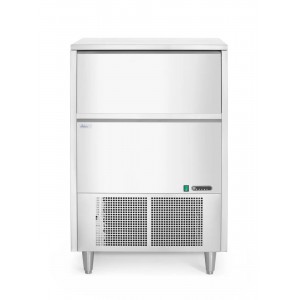
Commercial ice makers for a reliable supply of ice
A commercial ice maker provides a consistent supply for serving drinks, preparing cocktails, self-service stations and specialist food displays. It is suitable for bars, restaurants, hotels, cafés, catering operations, clubs, fish counters and other venues where purchased bagged ice is not sufficiently reliable or economical.
The Table-Line range includes compact manually filled machines, professional hollow- and full-cube ice makers, and equipment for flake or granular ice. Models differ in ice form, rated output per 24 hours, built-in storage, water supply and drainage, cooling method and installation requirements.
Which type of ice does your operation need?
- Hollow cubes or bullet ice provide a large cooling surface and suit soft drinks, water and high-volume everyday bar service.
- Full cubes are denser and generally melt more slowly, making them suitable for spirits, cocktails and longer service.
- Flake ice is small and mouldable, making it useful for chilled displays of fish, seafood, food or bottles and selected kitchen processes.
- Granular ice consists of small grains and is used for displays, selected drinks and specialist applications. Always check the stated use of the particular machine.
Ice form affects cooling speed, melting, drink dilution, presentation and dispensing. Define the main application before comparing machine output.
Daily output and storage capacity are different figures
The kg/24 h rating describes how much ice a machine can make under specified test conditions. Bin capacity shows how much finished ice it can hold at one time. A machine rated at 50 kg per day does not necessarily have a 50 kg storage bin.
Estimate demand during the busiest hour, the length of the peak and the time available for recovery. The integrated bin is generally not a freezer: it provides temporary storage and meltwater must drain away safely.
Compact machines for light or occasional demand
Manually filled models are practical for small venues, offices, mobile service or supplementary production. The compact Bullet ice maker, 230 V/100 W produces up to 12 kg per 24 hours, stores approximately 0.7 kg and requires no permanent water connection. This provides flexibility, but the small bin is not designed for heavy peaks.
The category also includes machines rated at 12 and 15 kg per day with a choice of three cube sizes. Check whether each model is manually filled or plumbed; compact dimensions do not automatically mean connection-free operation.
Commercial hollow-cube ice makers
Hollow cubes provide fast cooling and suit a high number of servings. The 20 kg/day hollow-cube machine has an approximate 5 kg bin, while the 45 kg/day model stores around 16 kg. Some machines use a paddle system and finger evaporator designed for more dependable operation with harder water, but appropriate water treatment and regular scale removal remain necessary.
Full cubes for slower melting
Dense full cubes suit longer cooling and premium presentation. The range includes professional models rated at approximately 20, 30, 40 and 50 kg per day. The 20 kg/day full-cube maker has an approximate 6 kg bin, while the 40 kg/day model stores around 15 kg.
Suitable inlet-water quality is essential for appearance, taste and reliable operation. Dilution also depends on cube size, drink temperature, the amount of ice and service time.
Flake and granular ice for displays and specialist uses
Flake and granular ice are not direct substitutes for conventional cubes. They conform around products, making them useful for refrigerated displays, fish and seafood counters, bottles and selected professional processes. The range includes machines rated at approximately 85 and 300 kg per 24 hours. For higher-output equipment, check floor loading, ventilation, water flow, drainage, electrical power and the logistics of moving the finished ice.
Water, drainage and ventilation are part of installation
Most professional ice makers need a permanent potable-water supply and drain. Check connection sizes and positions, permitted water pressure, maximum inlet-water temperature, required drain fall and whether a drain pump is needed. Hoses must not kink or allow wastewater to flow back into the machine.
An air-cooled ice maker needs sufficient space for air intake and discharge. Do not obstruct vents or install the unit beside a heat source. Front ventilation can make some models more suitable for restricted spaces, but the clearances in the manual still apply.
Actual output depends on operating conditions
Rated output is measured under defined conditions. High room temperature, warm inlet water, restricted airflow, scale and a dirty condenser can lengthen cycles and reduce production. Include a capacity margin rather than sizing solely from average daily demand.
Also compare dimensions, power supply, refrigerant, climate class, noise, service access and whether the machine can be removed from below a counter without dismantling surrounding furniture.
Water quality affects both the ice and the machine
Use potable water only. Hardness, minerals, chlorine, odours and particles can affect taste, clarity, scale formation and water-system performance. Select manufacturer-approved filtration or treatment based on a local water analysis. Filtration and softening are different processes and should address the actual water issue.
Replace cartridges on schedule, descale with an approved chemical and procedure, and complete the specified flushing and sanitising routine after extended shutdown.
Ice is food and must be handled hygienically
- Clean the interior, bin, scoop and accessible water parts according to the manual.
- Use a clean dedicated scoop, never a glass or bare hands.
- Store the scoop clean and outside the ice unless the instructions state otherwise.
- Do not store bottles, food or other objects in the ice bin.
- Remove chemical residues and complete the required rinse after cleaning.
- Inspect seals, spray nozzles, filters, the condenser and drain regularly.
Set cleaning frequency according to water quality, workload, environment and the HACCP plan. Electrical and refrigeration work should be carried out by a qualified technician.
Table-Line can help match the ice maker to your operation
For an accurate recommendation, provide the required ice form, peak hourly and daily demand, operating hours, ambient temperature, water quality, available connections and installation dimensions. This makes it possible to compare a compact unit, a professional hollow- or full-cube machine and flake or granular equipment against the real workflow.