Commercial electric water kettles provide hot water quickly in small and medium quantities.
Commercial water kettles are practical for preparing tea, instant drinks and other products whose recipe requires hot water. They are used in restaurants, hotels, cafés, breakfast rooms, bars, offices, meeting rooms, guest accommodation, public institutions and catering operations.
The Table-Line range includes 1.8, 2.5 and 4.2 L electric kettles, a temperature-controlled model and a robust 6 L kettle for a gas stove. Electric models provide rapid heating and straightforward pouring, making them more suitable for smaller consecutive batches than for continuous self-service dispensing to a large number of guests.
Compare capacity, power, heating time, temperature control, base design, dry-boil protection and the intended heat source before ordering. Browse the complete range of commercial hot drinks equipment for other preparation methods.
Which commercial water kettle should you choose?
The best model depends on the amount of water, frequency of use, required temperature and available power source:
- A 1.8 L electric kettle is a compact choice for individual stations, smaller breakfasts, offices, guest rooms and moderate demand.
- A 2.5 L electric kettle reduces refilling when several cups must be prepared within a short period.
- A 1.8 L temperature-controlled kettle suits teas and other products for which boiling water is not always the best choice.
- A 4.2 L electric kettle supplies more water in one cycle for smaller hospitality and catering stations.
- A 6 L gas-stove kettle does not require an electrical socket and is designed for use over gas.
Match the capacity to demand during one heating cycle.
Total daily attendance is less important than the amount of water required at one time. Multiply the cup volume by the number of servings in one cycle, then observe the permitted maximum fill level. Never fill a kettle above its MAX mark because boiling water may escape through the spout or lid.
A smaller model is easier to lift and may prepare the required partial quantity more quickly. A larger capacity reduces refill frequency but makes a full kettle heavier, requires more space and generally takes longer to heat completely.
For a compact station, choose the 1.8 L, 2150 W electric water kettle. Its housing and heating element are made from 304 stainless steel, while the separate 360-degree base allows the kettle to be lifted without its power cable.
The 2.5 L kettle suits several consecutive servings.
The 2.5 L, 2150 W electric water kettle has a separate power base and dry-boil protection. Its product information states that a full kettle reaches boiling point in approximately seven minutes and provides up to 12 glasses of water. Actual performance depends on the serving size, initial water temperature, supply voltage, limescale and operating conditions.
A larger kettle is useful when staff regularly prepare several teas simultaneously or fill smaller serving jugs. If only one or two cups are normally required, heat the necessary amount while remaining within the permitted minimum and maximum levels. This shortens waiting time and avoids unnecessary energy use.
Temperature control provides better precision for different types of tea.
Not every tea requires the same water temperature. Water that is too hot may emphasise bitterness in delicate teas, while water that is too cool may not extract the intended flavour. A variable-temperature kettle is therefore useful for green tea, white tea, yerba mate and other products with defined brewing conditions.
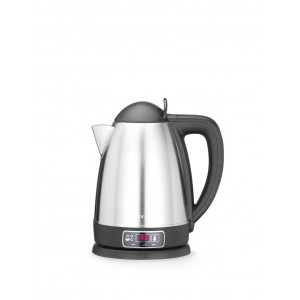
The 1.8 L, 1800 W temperature-controlled kettle provides settings of 40, 60, 80 and 100 °C and can maintain the selected temperature. It has a digital display, an AISI 304 stainless steel body and heater, a concealed heating element, a 360-degree base, automatic shut-off after boiling and double protection against operating an empty kettle.
The selected level is an appliance setting rather than a guarantee that every serving has exactly the same temperature when poured. Results are affected by the water volume, a preheated or cold vessel, elapsed time after shut-off and room temperature. Measure the actual temperature when a standardised recipe requires additional control.
The 4.2 L kettle reduces refill frequency.
The 4.2 L, 2000 W electric water kettle is the largest electric model in the category. It has a stainless steel housing and concealed heating element, an internal maximum-level mark, an operating indicator, automatic shut-off after boiling and double dry-boil protection.
Check the available counter height and depth and consider how the kettle will be poured safely. Four litres of water add substantial weight, so the user needs sufficient room for a stable grip and a clear route between the kettle and serving point. Do not carry a full, hot kettle further than necessary.
The 6 L kettle is designed for a gas stove.
The 6 L stainless steel water kettle has a lid and a traditional robust construction. According to its product information, it is designed for use on gas stoves. As it has no electric base, it suits kitchens and field catering arrangements equipped with an appropriate gas burner.
No automatic shut-off, temperature control or electrical dry-boil protection is specified for this model. It must remain supervised during heating, and its handles and lid should be treated as potentially hot. Do not assume compatibility with induction, ceramic or electric hobs without written confirmation from the manufacturer.
Electric kettles are intended for water rather than milk or other drinks.
The electric models in this range are stated to be suitable only for boiling water. Milk, mulled wine, prepared coffee, cocoa, soup and liquids containing sugar or particles may foam, burn onto the heating surface, enter electrical components or interfere with the sensors. Using an unauthorised liquid may damage the appliance.
Pour the heated water into a suitable cup, teapot or other vessel before adding tea, coffee or other ingredients. Do not place tea bags, loose leaves, powders or additives directly inside the kettle unless the instructions for the selected product explicitly permit them.
An electric kettle and a hot beverage dispenser serve different requirements.
An electric kettle heats a smaller amount of water, after which the user lifts it from the base and pours through the spout. It suits rapid preparation for individual orders or smaller groups. It normally has no tap and is not designed as a large self-service reservoir.
Commercial hot beverage dispensers have larger tanks, a tap and thermostatic control for extended temperature maintenance and repeated servings. Choose a dispenser or automatic refill boiler for continuous high demand, and an appropriate commercial coffee machine for preparing coffee.
Power supply and stable placement are essential for safe operation.
The electric models in the category are rated from 1800 to 2150 W and use a 230 V supply. Check the permitted circuit load before installation, particularly when a coffee machine, toaster, microwave or other high-powered appliance operates on the same circuit. Do not use extension leads or multi-socket adapters without verifying their permitted load and suitability.
- Place the base on a level, dry, stable and heat-resistant surface away from the counter edge.
- Route the cable so it cannot be pulled, stepped on or exposed to water and hot surfaces.
- Before switching on, check that the water is between the permitted minimum and maximum marks.
- Take care with steam, hot water and condensation around the lid when pouring.
- Do not force the lid open or fill the kettle while it stands on a connected electrical base.
- Disconnect the appliance before cleaning, extended periods of non-use or inspecting the cable.
Regular descaling maintains heating performance.
Limescale accumulates on the base, heating element, sensors and spout filter. Deposits may extend heating time, increase noise, affect the taste of the water and shorten the appliance's operating life. Match the descaling frequency to local water hardness and the number of daily cycles.
- Disconnect the appliance and allow it to cool completely before cleaning.
- Never immerse the electrical base, cable, plug or external electrical components in water.
- Use only a descaling method and product permitted by the instructions for the model.
- Rinse the kettle thoroughly after descaling and complete the prescribed cycle with clean water before service.
- Do not use abrasive pads or aggressive cleaners that may damage stainless steel, seals or plastic components.
- Inspect the lid, handle, spout, power cable and stability of the base regularly.
A tea box completes an organised hot drinks station.
The category also contains a 300 × 280 × 90 mm wooden tea box with 12 compartments and space for up to 144 tea bags. It is not a water kettle but an organiser for presenting several tea varieties neatly beside the kettle in a hotel, meeting room, café or self-service station.
Table-Line supplies water kettles for different hospitality settings.
Begin by defining the amount of water required per cycle. Then compare power, heating time, temperature control, the weight of a full kettle, available counter space and the energy source. Temperature control is useful for a selection of delicate teas, while the 2.5 or 4.2 L electric models and the 6 L gas-stove kettle provide more water in one batch.
For assistance, send us the expected number of servings, cup volume, frequency of use and details of the available electrical or gas connection. We will help you select a suitable commercial water kettle for your kitchen, breakfast room, office or catering station.