Commercial hot beverage dispensers prepare and serve larger quantities with controlled heating.
Professional hot beverage dispensers, also known as beverage urns or drinks boilers, heat compatible liquids and use a thermostat to maintain a selected temperature. An integrated tap dispenses individual servings without opening the vessel. These appliances are practical for hotel breakfasts, self-service buffets, catering, winter events, fairs, seasonal stalls, restaurants, cafés, canteens and public institutions.
The Table-Line range includes single-wall and insulated double-wall dispensers in several capacities, coordinated buffet designs, an automatic refill boiler, dedicated hot chocolate machines and a separate drip tray. Capacity is only one selection factor. Always check the permitted liquids, temperature range, power, heating time, cleaning method and available electrical supply.
A beverage dispenser is not automatically suitable for every liquid. Many models in this category are intended primarily for boiling tea water and heating mulled wine and are specifically unsuitable for milk or hot chocolate. Select a dedicated machine with continuous stirring for thick drinks. Browse the complete range of commercial hot drinks equipment for other preparation methods.
Which hot beverage dispenser should you choose?
Select the appliance according to the drink, peak serving demand, required heating time and installation:
- Single-wall dispensers are an accessible and practical choice for occasional or time-limited service of tea water and mulled wine.
- Double-wall dispensers use an insulated body to reduce heat loss during longer or repeated service.
- Compact models of approximately 9–10 L suit smaller breakfasts, meetings, offices and stations offering several drinks.
- Medium models of approximately 16–18 L suit hotels, restaurants, canteens and events with a steady flow of guests.
- Larger models of approximately 25–30 L reduce refill frequency at busy events but require more counter space and adequate electrical capacity.
- An automatic refill boiler connects to the water supply and supports locations with continuous high demand for hot water.
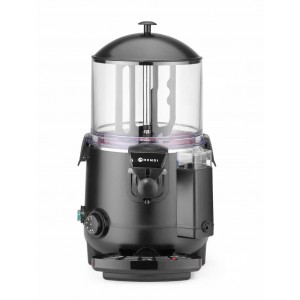
- A hot chocolate machine uses bain-marie heating and continuous stirring for a thick drink that is unsuitable for standard beverage urns.
Match capacity to peak simultaneous demand rather than total daily attendance.
Begin with the cup volume and the number of servings required during the busiest part of service. Divide the nominal vessel capacity by the serving size, then allow for the fact that the usable volume may differ because of minimum and maximum fill levels.
For a smaller station, consider the 9 L single-wall dispenser with 2200 W output. Its product information states that 9 L of water reaches boiling point in approximately 23 minutes. Actual heating time depends on the initial temperature, fill level and operating conditions.
For larger quantities, the 30 L, 2500 W hot beverage dispenser reduces refill frequency. A larger tank does not necessarily provide faster service: also compare the tap height, flow, recovery time and safe method of refilling.
A single-wall dispenser suits straightforward and time-limited service.
A single-wall vessel surrounds the liquid with one metal layer. This construction is lighter and usually less expensive but loses more heat through the body than a comparable insulated model. External surfaces may become hot during use, so handle the appliance only by its designated grips and follow its instructions.
The 18 L, 2200 W single-wall dispenser is intended for mulled wine and boiling tea water. Its stated maximum temperature is between 94 and 99 °C, and the listed time to boil 18 L is approximately 52 minutes. It is not suitable for hot chocolate.
For a larger self-service station, the 28 L, 2200 W dispenser provides temperature control up to 110 °C. According to its product information, the reversible lid can also be used as a tray or a surface for keeping cups warm.
A double-wall dispenser reduces heat loss during extended operation.
An insulated double wall limits heat transfer into the room, making it easier to maintain the set temperature and potentially reducing energy use compared with a similar single-wall unit. Insulation does not mean that every external surface remains cool, and safe handling is still required.
The 9 L, 2200 W double-wall dispenser has an adjustable thermostat up to 110 °C, an anti-drip tap, a glass level gauge and a descaling indicator. For higher demand, the 18 L, 2200 W double-wall model provides the same core operating concept at a larger capacity.
The 17 L, 2500 W double-wall dispenser can be set between 30 and 100 °C and includes a drip tray. Always check which components are included before comparing models.
Temperature range and power determine how the appliance can be used.
Products in this category differ in power and regulation. Selected dispensers can be set from 30 to 100 °C, while others reach approximately 94–99 °C or have thermostatic control up to 110 °C. These values do not apply to every model.
Higher power may shorten initial heating, but wattage is not the only factor. Heating time also depends on the quantity and initial temperature of the liquid, vessel construction, thermostat setting, room temperature and opening of the lid. The thermostat regulates the appliance; it does not replace measuring the actual drink temperature or following the procedures in your HACCP system.
Add together the power demand of every appliance on the same circuit before installation. Several dispensers rated between 2200 and 2600 W can exceed the capacity of one circuit even though each uses a standard 230 V connection.
Standard dispensers may only be used with liquids permitted for the specific model.
Many appliances in this category are explicitly intended for tea water and mulled wine. This does not automatically make them suitable for prepared coffee, milk, cocoa, drinks containing particles, fruit pulp or thick mixtures. These liquids may stick to the heating surface, foam, complicate cleaning or block the tap.
For a coordinated buffet arrangement, consider the 9 L, 950 W UNIQ dispenser and the 16 L, 1650 W UNIQ dispenser. Both can be set from 30 to 100 °C and are intended only for boiling water or heating wine, not for milk or hot chocolate.
If you need smaller quantities of hot water without a large self-service reservoir, compare the range of commercial electric water heaters. Use an appropriate commercial coffee machine to prepare coffee drinks.
Hot chocolate requires a dedicated machine with continuous stirring.
Hot chocolate is thicker than water and wine and may stick to a directly heated base. A dedicated machine uses bain-marie heating, transferring heat through a water bath. Continuous stirring helps maintain a uniform consistency, while the tap is designed for a thicker drink.
The 5 L, 1006 W hot chocolate machine provides a temperature range from 65 to 85 °C, overheating protection, continuous stirring and a drip tray with a fill indicator. For more servings, select the 10 L hot chocolate machine with the same stated power and temperature range.
The permitted ambient temperature for both models is stated as 10 to 32 °C. Use a recipe and process allowed by the appliance instructions, and control dairy or other perishable ingredients according to your HACCP plan.
An automatic refill boiler supports continuous demand for hot water.
Staff must fill a standard beverage urn manually. An automatic refill model connects to the mains water supply, adds water when the level falls and heats it again. This arrangement suits hotels, breakfast rooms, canteens, conference centres and other locations requiring a continuous supply of hot water.
The 17.5 L, 2600 W automatic refill boiler has a digital display, two water-level sensors, a 30 to 100 °C setting, keep-warm mode and overflow protection. Its stated heating capacity is up to 33 L per hour.
Before ordering, check the water and electrical connection points, water pressure and quality, filtration requirements, drainage for possible spills and the space required for service access. Installation should follow the product instructions and be completed by a suitably qualified person.
Tap clearance and a drip tray affect everyday service.
Check the distance between the tap and base before ordering. Selected UNIQ models provide a stated maximum cup height of 100 mm, while some other dispensers allow 130 mm without the drip tray. A tall vacuum jug therefore cannot fit under every appliance.
An anti-drip tap helps reduce spills but should not be treated as completely leakproof. Inspect the seal and remove drink residues regularly. The 145 × 157 mm beverage dispenser drip tray combines an ABS base with a stainless steel upper tray and is described as suitable for the single-wall and double-wall dispensers in the range.
Safe installation requires a stable surface and adequate electrical supply.
- Place the appliance on a level, stable, dry and heat-resistant surface away from the counter edge and routes used by guests.
- Before filling, check that the tap is closed, the lid fits correctly and the liquid remains within the permitted minimum and maximum levels.
- Do not move a full or hot appliance. Take care with hot steam and condensation when opening the lid.
- Route the cable so it cannot be pulled, stepped on or exposed to water and hot surfaces.
- Use only liquids, ingredients and temperature settings allowed by the instructions for the selected model.
- Monitor the liquid level during operation. Do not operate an empty unit unless its instructions specifically permit this.
- Disconnect the appliance and allow it to cool before draining, moving or cleaning it.
Regular descaling maintains heating efficiency and tap flow.
Limescale accumulates on the heating element, sensors, walls and inside the tap. It may extend heating time, interfere with level or temperature detection and reduce the flow rate. Match the cleaning frequency to the water hardness and intensity of use rather than relying only on an indicator light.
- Disconnect the appliance and allow it to cool completely before cleaning.
- Never immerse the electrical housing, cable or plug in water.
- Clean the tank, tap, level gauge and removable components according to the model instructions.
- Use only a permitted descaling product and rinse the appliance thoroughly after the process.
- Do not use abrasive pads or aggressive cleaners on stainless steel or transparent components.
- Before reuse, check the tap seal, correct assembly and condition of the power cable.
Table-Line supplies beverage dispensers for different drinks and service volumes.
Begin by defining whether the appliance will heat water, mulled wine, hot chocolate or another explicitly permitted liquid. Then compare capacity, wall construction, power, temperature range, heating time, cup clearance, filling method and cleaning requirements.
For assistance, send us the drink, serving size, expected number of servings during the busiest hour and details of the available electrical and water connections. We will help you select a suitable beverage dispenser, automatic refill boiler or hot chocolate machine.